Showing posts with label Geneva. Show all posts

Wednesday, 20 January 2021

August 1941, A Picnic in St Andrew's East and a Visit to the Farm

This post shows a visit by cousins from Drummondville, Quebec - Charlie and Dora Hardy.

(DJ Gagnon is writing this post and my father is LC Gagnon. George, Mabel and Rosemary comprise LC's immediate family.)

According to the photo book, this picnic spot is somewhere south of St Andrew's East.

If you want to see more detail, just right click on the photo and open it in a new tab.

Above: Charlie Hardy, George Gagnon, Rosemary Gagnon, Dora Hardy, Mabel (Rodger) Gagnon.

The picnic fare seems rather spartan. 
However, Canada has been fighting World War 2 for almost two years at this point and 
Hitler invaded the USSR a couple of months before this photo was taken. 
Many food items and fuel are being rationed. 

Above: George, Dora, LC Gagnon, Rosemary Gagnon, Mabel Gagnon.
LC Gagnon (and later his own kids) was encouraged to take snapshots from an early age. 
If you don't see him in the photo, he is probably taking it.

Because of a child's rocking chair, we were continually reminded of the name 'Charlie Hardy'. 
Below are my father's notes on who he is.


Above, DJ Gagnon (writing this account) and my aunt Rosemary Gagnon are seen
20 years later in August 1961. Rosemary has returned from a trip to Bermuda.

I am sitting on 'Charlie Hardy's rocking chair'. 
Notice the glossy red paint which probably contains lots of lead.

The farm visited belongs to WJ Rodger. Mabel Gagnon is WJ's oldest child.
This location is just south of the 'post village' of 'Geneva', Quebec.

... Before the uniform municipal naming of streets and numbering of residences,
the postal system arbitrarily named locations where someone was paid to act as a postal agent.

Above, is a view of the hen house and some Clydesdale horses.
During a time of rationing, it is handy to know someone who produces things like eggs.

Mabel, Dora, Bea (Hugman) Rodger. 
Bea is the spouse of Douglas Rodger, WJ Rodger's youngest child. 
There were six children in WJ's family.

Bea Rodger, Mabel, George, Rosemary, Dora, Charlie, WJ Rodger.

Notice under Charlie's left arm is a 'box camera' - the most common snapshot camera of the era.
The camera would be held at waist height, with the operator looking down to frame the shot.
Each viewfinder contained a mirror which redirected the view by 90 degrees. 
Generally there were two viewfinders to provide for either portrait or landscape orientation.

The box camera roll film used in the (back of the) camera was quite large 
so the viewfinders were both tucked in a front corner of the camera.
The light coming through the snapped shutter spread out in a big cone to hit the film at the back.

Later, when snapshot cameras were redesigned to use smaller rolls of film
... probably because of improvements in lens manufacturing and to make the hobby cheaper ...
a simple viewfinder was sighted at eye level.
When the shutter release opened, the light entered the camera,
parallel to the viewfinder path and just below it.


WJ Rodger, Charlie Hardy, George Gagnon, Stanley (SW) Rodger.
SW is WJ's fourth child. Behind the Case tractor is Charlie Hardy's car.

Douglas Rodger is cutting hay.

My great-uncle Douglas was my first boss when I worked on this farm 
during the summers of 1973-75.
Working there was the best job I ever had.


Saturday, 1 August 2015

May Day, 1965

from the archives of LC Gagnon

North River dam at St Andrew's East.


Wales house from the bridge.


Main Street looking east toward bridge.


Former Wales store.


Main Street, looking north to Post Office.


Old road looking north near Bradley's.


Old road looking north toward Douglas Rodger's.


Disking May 1, 1965.


DA and SW Rodger in a Saturday morning conference.


After a hearty farm lunch, some light entertainment in the parlour.


Without question, the kids' favourite part of the 'Lachute visiting circuit'.


... back to the day's scheduled work.


Unscheduled photo opportunity - by popular request.

*  *  *

Reciprocal visit to Lachine - May 28, 1965

Living only 60km away, it was not unusual to have visits from the farm too.
On this particular occasion, it was a visit to our parents'  just-purchased first house.

Lachute Farm Staff Car departing ...
In four weeks, things have 'greened up' quite a lot.

Friday, 31 July 2015

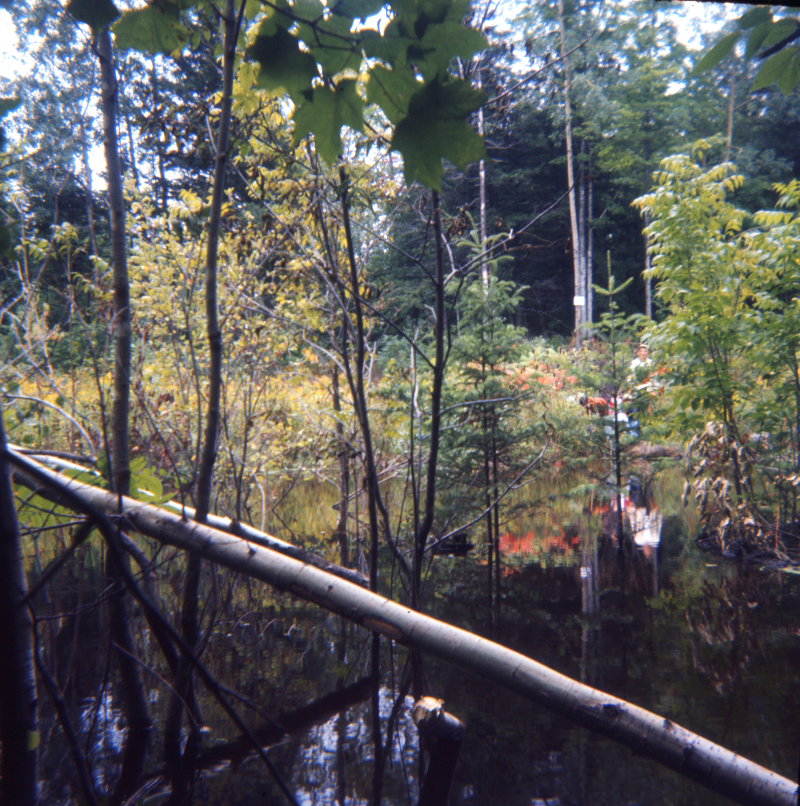
The Beaver Dam - August 27, 1966.

from the archives of LC Gagnon

Many of us had never seen, or been this close to, a beaver dam.
As always, the farm was the source of many wonders.

The Volkswagen is waved ahead.


The way in.


At the dam.


Conservation officials.


Some members of the expedition.


Seen from the opposite side.


Waterworks.


Sightseeing on the way back.


Visiting in the field. At the left margin, a bovine horn approaches the photographer.


... back to the day's scheduled work.


Saturday, 13 June 2015

We Sat Right across from Hitler


An Introduction


Like my grandmother Mabel Rodger, my great aunt Mary Elizabeth Rodger (Bessie) became a teacher and went on an Overseas Education League teachers' tour organized and conducted by Major Frederick Ney.

My grandmother went over in 1922, shortly after this movement's beginning. She was shown the 'Centre of the Empire', Paris, Rheims and the 'battlefields of France' from the Great War, 1914-1918.

Bessie went over in 1938. She travelled more into Europe itself, as the title hints.

*  *  *

My knowledge of Major Frederick Ney has been enhanced by two papers:

1. Mapping the Serious and the Dangerous: Film and the National Council of Education 1920-1939; Charles R Acland; 1995; Erudit.org
"... The NCE was a significant force; it was a powerful lobby, initiator of cultural activities, and producer of cultural criticism. The NCE was imperialist in orientation, and took as one of its goals the improvement of popular taste. Its members encouraged the regulation of recreation and modes of popular pleasure so that leisure time served the nation. This educationalist agenda led them to promote documentary film and to write about the dangers of popular cinema ..."
"Major Fred J. Ney, executive secretary of the National Council of Education (NCE), prepared a film and lecture for the NCE fourth triennial conference on "Education and Leisure" (1929) portraying the '... manner in which the morals of young Canadians are being assailed by a flood of foreign magazines depicting immorality, violence, vice and crime.' "

2. "First Unto God and then to the Queen": Frederick Ney's Empire/Commonwealth Youth Movement from the Inter-war Period to the 1960s; Jialin Christina Wu; 2014; hal.archives-ouvertes.fr

*  *  *

While in Europe, my 34 year old great aunt replied to her nephew's persistent letter-writing efforts with letters and postcards. My father was 11 years old at that point. In researching some Geneva PQ history in my father's files, I found one of her accounts to my father particularly surprising and interesting.


The 'security pattern' to hide the message carried within the hotel air-mail paper envelope was a photo of the hotel itself. It was intended to visually 'bleed' through the front of the envelope to promote the hotel, and so was printed in reverse on the envelope interior. In turn, I have reversed the image to show you the hotel and the historical era, above.

In my father's files are also preserved Bessie's trip account letters to her Aunt Alice Gall - her mother's sister. No mention of Hitler is made in this correspondence.

While researching this trip, I was particularly fortunate to have a chance contact with my cousin, Robertson Dow, who kindly provided me with our great aunt Bessie's diary of her experiences.

Bessie's letters to my father and Aunt Alice Gall provide interesting hi-lites of her experiences in continental Europe for those particular readers. In contrast, Bessie's diary (covering the period June 25 to July 26, 1938) is more methodical as it records the tour's itinerary and her observations of people, institutions, cities, cultures and countries. Some of these had already changed since Hitler's rise, some would be scarred forever, others would be destroyed. 

*  *  *

Eight full months prior to Bessie's trip to Munich, the Duke and Duchess of Windsor (formerly King Edward VIII and Wallis Simpson) had visited Hitler at his Bavarian mountain retreat. This was done against the wishes and advice of the British government.


from: Hitler; Ian Kershaw; 1998; Penguin Books.

By the time of the Windsors' visit, Hitler had appointed himself head of state and supreme commander of the armed forces. He had told his military commanders to be ready for war as early as 1938. Those who had expressed concerns about the armed forces' readiness for this course of action at that early a date were replaced.


In July 1938, Major Ney took Canadian and other Empire school teachers, including Bessie, for a tour of that Europe and that Germany. Did Major Ney have a particular view about what was happening in Europe? One of the papers recounts the following developments with Major Ney's film education organization, which occurred midway through the Great Depression in Canada ...

from: Mapping the Serious and the Dangerous ... 
"While 1934-35 saw the NCE's most extensive involvement in film, other activities were causing significant disruption. The council's increasingly public support for fascism, as seen in its invitations for Italy Week, was drawing criticism from many. Some prominent politicians felt they had to withdraw, among them Prime Minister RB Bennett, for fear of being tainted by scandal. Vincent Massey, a past president of the NCE, resigned, writing to Ney, 'I don't think I need tell you that I have always had a very sincere belief in the National Council and the work it set out to do; but of late, although the criticisms levelled against it are often unjust, sometimes I confess I cannot help sympathising with them.' "

If Great War veterans and witnesses such as Major Ney and the Duke of Windsor 'did not get it' .. could Mary Elizabeth Rodger from Geneva, Quebec foresee what was to going to happen to Europe?

*  *  *

Bessie died when I was ten and I only have a couple of distinct memories of her. I remember her being quite a rational and direct person, but nice. For example, at one point she introduced me to the idea that even after school and sleep, I still had many hours available to me - we added them up together - we all have the same 24 hours in a day, but it depends how we choose to use them.

Except for his composition of her obituary, and following-up aspects of her estate with the school board - both at the request of her brother - my father's file about her is particularly thin.

The following photo of her professional colleagues was in the file, along with a few notes added by my father. She can be seen in the centre of the centre row - 'Miss Rodger'.


In our family albums is this photo of me with Bessie Rodger
at our Lachine apartment, twenty years after her travels in Europe.

In the following postings, I'll try to explain what was happening all around her as Bessie toured with her group. Again, this tour was arranged and often conducted personally by Major Ney.

*  *  *

As an example:

On the day before she saw Hitler, Bessie woke up in Nuremberg ...


from: Speer, The Final Verdict; Joachim Fest; 1999; Harcourt Books.
The Nazi facilities at Nuremberg seen by Bessie.

By 1927, Hitler had decreed that the annual general meeting of the Nazi party would be held at Nuremberg "forever" as the ancient city with its preserved buildings was a "symbol of the first Reich of the Germans". The annual general meeting was not a forum where party members passed resolutions about policy - rather, it was a quasi-religious experience during which the individual was subsumed into the German Reich which was personified by Hitler.

The purpose-built Nazi theme-park on six square miles of land (which had previously been known as Luitpoldhain and had served as a large Nuremberg park with a Great War memorial which was added later) was to be greatly expanded by a young architect, Albert Speer - he was about a year younger than Bessie. The entire complex was set for completion by the autumn of 1945. Major features were completed before then. Speer used up to 150 anti-aircraft searchlights to produce a 'dome of light' effect seen above. Much of the Nazis' grandiose, 'brutalist' architecture was also created under Speer's supervision.

Speer got his start producing rallies in April 1933 when he joked to a Party official that the plan for a Nazi May Day rally in Berlin reminded him of a 'village rifle club event'. The Party official told Speer to go ahead with the improvements he suggested. Hitler and Goebbels liked his work on that project.

Speer and Hitler eventually became each other's protégés. If he had not narrowly missed a career in the visual arts in Vienna ... and if he had not succeeded at being a European dictator ... Hitler discovered through his work with Speer that his true professional calling was to become an architect.


Two postcards from my collection, Nuremberg, circa 1900-1910.
The old town of Nuremberg seen by Bessie.

The green domes in the top postcard are those of the Great Synagogue of Nuremberg. It was expropriated at the behest of the Nazis and then demolished, beginning on August 10, 1938 - a month after Bessie's visit to the old city.

Because of its significance to the Nazis, RAF Bomber Command made many efforts to bomb Nuremberg with little success. In the process, it suffered great losses in the form of bomber aircraft and their crews - many of whom were Canadian. 

Finally, on the night of January 2-3 1945; 514 Lancaster and 7 Mosquito bombers hit the target. "The castle, the Rathaus [town hall], almost all the churches and about 2000 preserved medieval houses went up in flames." Almost 2000 people were killed. 
from: The Bomber Command War Diaries, 1939-1945; Martin Middlebrook; 1985, Viking.

*  *  *

In a single daily diary entry, Bessie recorded seeing these large physical artifacts which would no longer exist after the passage of a few years. Not all of her entries precede such a clear and dramatic change, but many do.

Regarding her late-day arrival in Munich, she wrote:

"Went for a walk, but too much traffic. There was a celebration of some kind in the city."

It was a celebration of "German Art". Munich had been the location of Hitler's failed Beer Hall Putsch in 1923 and the 'martyrs' of that era were venerated by the Nazis. Munich was the site of the Great German Art Exhibition and also the Degenerate Art Exhibition. In the end, the latter was better attended by German visitors: 400,000 versus three million. 

The next post will look at Bessie's record of her experiences in Munich. You would be correct in concluding that Major Ney's group was not shown the Degenerate Art Exhibition.

Sunday, 26 April 2015

Tilling Geneva's Spring Soil


Because of my father's interest in Geneva and its farming, he saved a few old farm equipment publications for about 70 years. They somehow survived seven or eight changes of domicile over the decades and this seems like a good time to share them with you.

Back in the 1930s, farming was an industry with lower 'barriers to entry' and so was the manufacture of farm equipment. With supportive tariffs, Canada had a significant farm equipment manufacturing sector, and a domestic steel industry to provide its chief raw material.

Below are a few representative images of implements used in Argenteuil in the springtime of the 1930s and 1940s. Given their simple robust design, they might last decades after their original purchase. The images are arranged roughly in order of increasing technological complexity - not necessarily in the order in which the implements would be used during the season .. 

Most heavy plowing would usually occur in the fall. In the spring, farmers waited until fields were dry enough to support machinery. They would start preparing a seedbed, often including some fertilizing. When the time was right, seeding would take place. If necessary, mechanical cultivating might be done with some crops to eliminate weed competition for the natural resources needed by the crop.

Naturally, the process was more complex with more variables - but that's the general idea.


*  *  *


from booklet: McCormick-Deering Plows Drills and Tillage Implements c1937 - collection of LC Gagnon.


from booklet: McCormick-Deering Plows Drills and Tillage Implements c1937 - collection of LC Gagnon.


from booklet: McCormick-Deering Plows Drills and Tillage Implements c1937 - collection of LC Gagnon.


from booklet: McCormick-Deering Plows Drills and Tillage Implements c1937 - collection of LC Gagnon.


from folder: Massey-Harris Field Cultivators, 1941, collection of LC Gagnon


An Implement for Planting Seeds
(next two images)


from booklet: McCormick-Deering Plows Drills and Tillage Implements c1937 - collection of LC Gagnon.


from booklet: McCormick-Deering Plows Drills and Tillage Implements c1937 - collection of LC Gagnon.

*  *  *


A Corn Planter
(next 3 images)


from booklet: McCormick-Deering Plows Drills and Tillage Implements c1937 - collection of LC Gagnon.


from booklet: McCormick-Deering Plows Drills and Tillage Implements c1937 - collection of LC Gagnon.

.. as peas and beans are legumes (which fix atmospheric nitrogen in their roots), planting them with corn would probably provide both ground cover against weeds for this year's crop, and soil nitrogen for next year's crop. Corn needs plenty of nitrogen.


from booklet: McCormick-Deering Plows Drills and Tillage Implements c1937 - collection of LC Gagnon.


from booklet: McCormick-Deering Plows Drills and Tillage Implements c1937 - collection of LC Gagnon.


from folder: The Key to Greater Farm Profits, McCormick-Deering, c1937, collection of LC Gagnon