Showing posts with label British Empire. Show all posts

Saturday, 28 February 2015

At Oxford and Stratford


Continuing with my 22-year-old grandmother's 1922 summer tour for teachers from Canada (and other British Dominions and Colonies) to Britain and the battlefields of France with the Overseas Education League .. 

In the previous post, she had crossed the North Atlantic on the Canadian Pacific steamship Scotian. On docking at Southampton, the group was taken to London to where they would finally meet Major Frederick Ney - who was making the final arrangements for the group's tour. Contrary to the original printed itinerary, I believe they must have first rallied at the Pembridge Gardens Hotel in London, rather than travelling direct to Oxford by special train from the Southampton docks.

While he appears in OEL literature as the 'Honorary Organizer' Major Ney was actually the originator, promoter, main organizer and key person raising funds and 'services in kind' to transport, shelter, receive, educate and entertain the groups. His devotion to his mission spanned a period of decades from the time before the Great War 1914-1918 until after the Second World War and into the 1950s.
In writing these posts, I am using the terms Colony, Dominion and Empire as Major Ney employed them - for historical reasons. Many Canadians were thoroughly finished with the concept of 'Empire' after the Great War.  
Further, on terminology: Recently-written scholarly papers on Ney state that he continued to promote the 'Empire Youth Movement' as the name for his student tours even into the 1950s rather than using the term 'Commonwealth'. There was debate about this as .. 'some officials felt strongly that "the word Empire stirs up so many noxious feelings" in the colonies'.

The map below shows the British railway system circa 1900. Southampton appears at the south-west corner of the map. From London, the group would have travelled roughly west to Oxford and later to the north-west corner of the map to visit Stratford-on-Avon, before returning to Oxford.
from: Handy Reference Atlas of the World; J G Bartholomew; 1904; London.


from: The Railways of Britain, Past and Present; OS Nock; 1947; BT Batsford, London.
The Southampton docks after World War 2. The ship-to-passenger-train connections may have been made at the far side of the docks. In the centre is a large ship in a floating drydock.


from: Alden's Oxford Guide 1903; Alden and Co Ltd, Oxford.


[note: it is actually a 'Norman crypt' or Romanesque.
The Victoria League program - see July 16 - below is incorrect.]
from: Alden's Oxford Guide 1903; Alden and Co Ltd, Oxford.


from: Google Earth, 2015

I believe this was the house to which Mabel and three others were invited for tea after church.


The Victoria League was a voluntary charitable organization which still exists. Back in this era it functioned as a type of Imperial glue to foster better relations with the far-flung parts of the Empire. A similar organization existed in Canada - the Imperial Order Daughters of the Empire - "One Flag, One Throne, One Empire". As the IODE was not at the 'centre of the Empire', it generally felt it was getting short shrift from the VL and the relationship always suffered accordingly.


from: Alden's Oxford Guide 1903; Alden and Co Ltd, Oxford.
The martyrs were: Thomas Cranmer, Nicholas Ridley, Hugh Latimer.


from: Alden's Oxford Guide 1903; Alden and Co Ltd, Oxford.


Letter continued from above:

'We spent Friday at Stratford ..'


from: Stratford on Avon; HW Tompkins; 1904; JM Dent, London.

from: Stratford on Avon; HW Tompkins; 1904; JM Dent, London.


In a small, separate album, I have found a handful of tiny, uncaptioned prints of Mabel's tour with the OEL.

Mabel Rodger (right) and fellow OEL tour participants in Britain


Beginning the tour at Oxford and Stratford immediately presented several concepts about 'the centre of the Empire' to the teachers just arriving from the Dominions and Colonies. Here are a few passages from the letter above:
  • We have been through all the Oxford Colleges and all they contain and show would take a month for me to relate. 
  • .. the English well-to-do people are so nice. 
  • .. the afternoon teas we are invited to are unexplainable. 
  • .. we have scenery at home it is Nature's; here, everything is so well preserved.

The women teachers stayed at an ancient centre of knowledge which had existed for 800 years and which had eventually been 'encouraged' to provide undergraduate examinations to women for almost 50 of those years.

Reference was made to the monarch-centred mother church of the worldwide Anglican Communion. Local church officials had been martyred for their beliefs by a church based in Rome.

The teachers were warmly received into a sophisticated foreign social sphere with its own complex traditions and customs.

They were taken to the home town of an astute observer of the human condition - whose observations were still apt 400 years after his death. His works were widely known and studied in their home Dominions and Colonies.


In terms of understanding The Empire .. the teachers had seen little of what made it a successfully functioning 'empire' up to this point in the tour. The things they saw were worthy of continued preservation because human knowledge and genius, and ancient objects of aesthetic beauty, are worthy of careful preservation.

*  *  *

There are more letters and artifacts to follow. I have only skimmed the letters to ensure they are in chronological order before I assemble the components for each post.

There is also the 15-page manuscript my grandmother prepared about her tour. This was presented, by invitation, as a speech to a meeting sponsored by the Women's Institute after her return to Canada.


Monday, 16 February 2015

Across the Ocean


In the previous instalment of Mabel Rodger's saga, she had graduated from Macdonald College, was working as a teacher and was about to depart on a summer trip to Europe with the Overseas Education League. 

The previous post presented the instructions and hints for the trip and some background on the OEL and its stated mission

Here is my grandmother's account of her trip across the Atlantic, along with artifacts related to that event. 


This uncaptioned photo appears in the previous post and is the only image of the trip which I have found. Although Mabel is holding a box camera (extreme right), no photos from the trip have yet surfaced.


The 'paquebot' cancellation was familiar to me in the sense that the term is still used on television in Quebec to refer to an ocean-going ship. Paquebot - a corruption of the English for 'packet boat' - was a special cancellation used by international agreement. For a while, French was the international 'diplomatic language' of Europe and this may explain the choice of this particular term.

Consider that mail might be created and 'posted' on a ship of a particular flag. On reaching the next port, the mail would handed off to the national mail system of that port (often in another country) and cancelled. The 'paquebot cancellation' respected the national postage of the ship's flag (i.e. foreign) and then the mail was forwarded in the normal manner.

The fact that the envelope is stamped with a 'three halfpence' stamp on dry land at Southampton kind of torpedoes the 'mail at sea' reason for using the cancellation. And I just realized that I could be off searching for photos from the trip if I weren't trying to understand the work of an English mail clerk a century ago. (Update, Feb 18: Surprised! - I actually find some photos.)

At any rate, we are able to read my grandmother's account of this trip because her letters were preserved and returned by the woman in the photo below.


Here is a photo of Alice Gall, my grandmother's maternal aunt. Below are 'Aunt Alice's' siblings as noted by my father on the back of the photo.


My grandmother's letter follows.


Firmly glued into my grandmother's Macdonald College yearbook/scrapbook are the following artifacts.


from the previous post:

The Canadian Pacific Steamship Scotian was a single-stacked passenger liner in use between 1898 (built in Belfast by Harland and Wolff) and 1927 (scrapped). In terms of size: it was about half the length and beam of the Queen Mary with about 15% of its 'tonnage'. It had a top speed of about 15 knots. In the Great War, it was first a troopship, then a prison ship for German POWs until being taken over by the CPR in 1917. The touring party returned to Canada on another ship.


In another Canadian Pacific Steamships envelope is preserved this 'group identification' marker for the tour. This simple item was attached to the group member's clothing using a safety pin.


from: The Citizen's Atlas of the World; John Bartholomew & Son, Edinburgh; 1924.
Here is how the North Atlantic was represented in an atlas of the same decade.


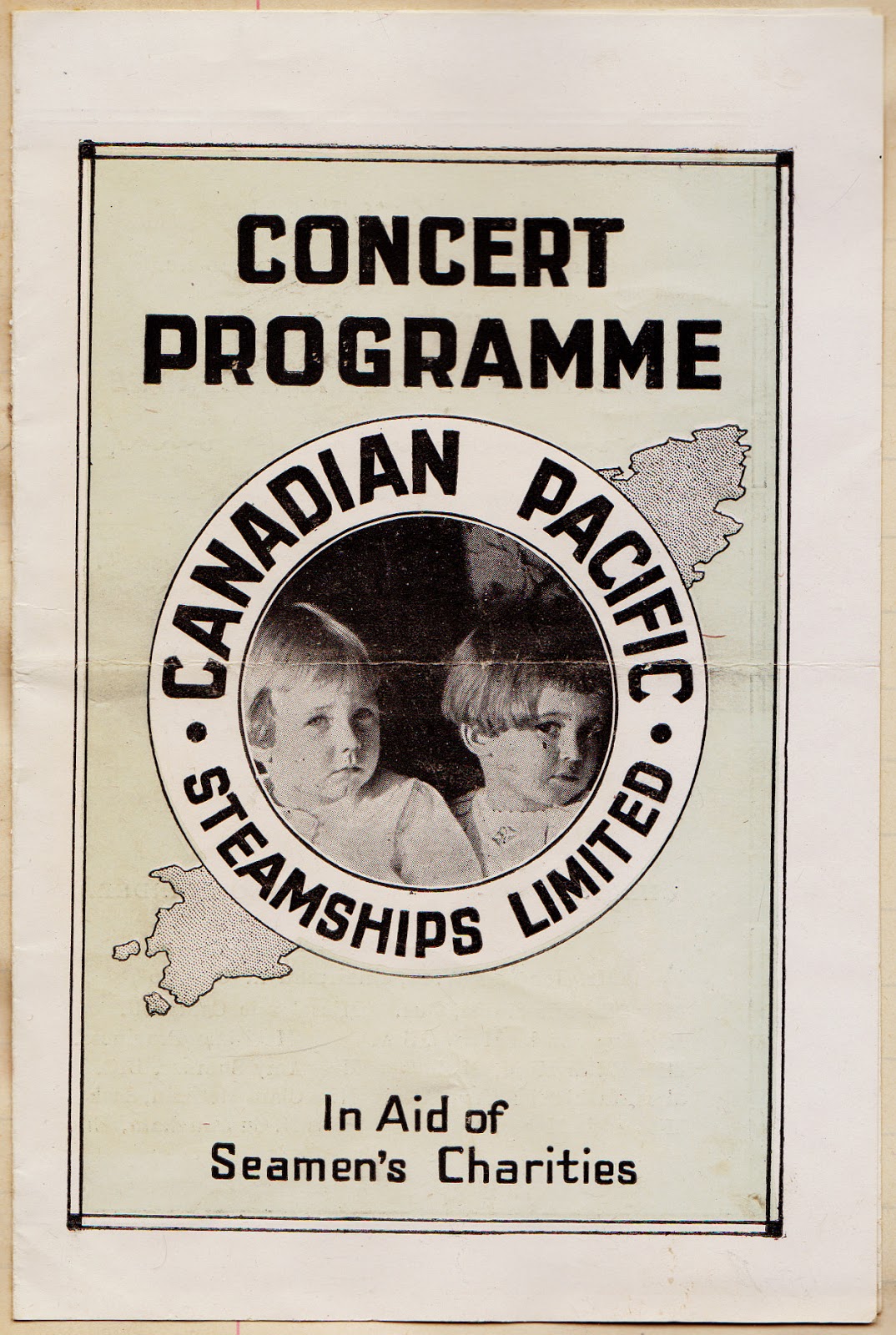
Concert Program Cover


.. Passing the hat among women teachers to benefit the widows, orphans and dependents of former employees of a large, profitable corporation which had been paid to work in the service of the Empire during the Great War ... would not be questioned after all the other great sacrifices of the war. The Empire was sustained through duty and sacrifice. 


During this period, long before photocopiers, passenger ships usually had their own printshops. They printed menus and other documents used while at sea. Large ships often produced and supplied upper class passenger manifests - so people could have a souvenir of their trip in 'Second Class' or become aware of acquaintances or celebrities sailing with them during the multi-day voyage.

In this case, the OEL touring party had the entire ship booked for their tour group. So this was a 'concert' they put on for themselves. 

Preparing to stage this event could have served several purposes:
  • To pass the time while travelling about 3050 nautical miles at a maximum speed of 15 knots.
  • To reduce homesickness. 
  • To distract group members from any anxiety about the danger of an ocean voyage (this was 10 years after the Titanic sinking - 1500 lives lost; 8 years after the Empress of Ireland sinking - 1012 lives lost; and 4 years after the Great War).
  • To encourage socializing and familiarity with other members of the group - especially those from distant Dominions and Colonies of the Empire.
  • To help focus group members on their future 'mission' of understanding and promoting the British Empire to their school students.
  • To enable tour officials to assess the talents and abilities of potential leaders within the tour group.

In general, the tour leaders used the isolation of the voyage to inculcate the ethics of the Overseas Education League and its mission - a combination of 'fun boot camp' and mild brainwashing in the service of the Empire. This would help prepare the teachers from the Dominions to appropriately appreciate all the grandeur of Britain they were to see during the two months of their experience.
  

Concert Program Interior

Thursday, 1 January 2015

The teaching profession, your country and the Empire


The title comes from text within 'A few hints to the members of the party' 
written by The Rev E Crummy, BSc, DD, Hon Chaplain and Lecturer

My grandmother, Mabel Rodger, having graduated from Macdonald College in 1920 with a First Class Model School Diploma, went on a trip to Europe with other teachers in 1922. This trip was provided and operated by the Overseas Education League. 

As you will see, the leader of the tour - Major Frederick Ney, MC (Military Cross) - was an accomplished citizen of the Empire who served with distinction during the Great War, 1914-1918. He also had particular views about which cultural objects and which ideals should be elevated in society.

This is an artifact-rich and (I believe) formative period in Mabel's life, and several posts will be dedicated to fully documenting her experience. Exploring the views and later projects of Major Ney will also provide historical insights into some of the ideas competing for influence within Canadian society at the time.

The artifacts reproduced in this post are very firmed glued into Mabel's Macdonald College 'yearbook/scrapbook' and have been carefully scanned from within that book.


Frederick James Ney (1884-1973)
 [text copied directly from: The Manitoba Historical Society website]

Educator.

Born at Westfield, Sussex County, England on 17 September 1884, son of Mr. and Mrs. Edward F. Ney, he was educated at Rye Grammar School and privately. He was headmaster at the English College at Nicosia, Cyprus; and Headmaster of St. Mary’s High School at Cairo, Egypt. He came to Canada in 1909 where he was Headmaster at the West Treherne School, then Russell High School (1908-1909), and Chief Secretary of the Department of Education for the Manitoba Government.

In September 1914, he joined the Canadian Expeditionary Force, serving with the RAMC [Royal Army Medical Corps], being gazetted as a Captain and sent overseas where he transferred to South Wales Borderers, 1916 (25th Division). He was in France from 1915 to the end of the war, seeing service in Ypres and Mons and was mentioned three times in dispatches. He was awarded the Military Cross (Messines), Belgian Croix de Guerre, and French Croix de Guerre. He was promoted to a Major on the eve of the armistice and was, for a time, specially attached to French Army in charge of large Motor Ambulance Convoy. He returned to Canada in 1920 and resumed his position with the Department of Education.

He married Helena Aikins, daughter of J. A. M. Aikins. He was the Founder and Honorary Organizer of the Overseas Educational League, Executive Secretary of the National Council of Education, and Honorary Secretary for Canada of the International Moral Education Congress. As organizer of the Overseas Education League, he was responsible for the organization of the scheme of Interchange of Teachers between Canada and other parts of the British Empire. As Secretary of the National Council of Education, he was responsible for the organization of the National Lectureship scheme, inaugurated in the spring of 1923 by Sir Henry Newbolt and Sir Michael Sadler.

He was awarded the Gold Medal of the City of Paris presented by the President of the Council at the Hotel de Ville, 19 July 1923. He was a member of the Masons (Wellington Lodge, No. 22, Rye, England), United Service Club (Winnipeg), Arts and Letters Club (Toronto), and Royal Colonial Institute (London, England).

He died at Nanaimo, British Columbia on 7 March 1973 and was buried in the Cedar Valley Memorial Gardens at Nanaimo.


*  *  *


Below, in this post, is a general orientation and preparation guide for teachers travelling on the Overseas Education League's Visit of Teachers during the summer of 1922.

The Canadian Pacific Steamship Scotian was a single-stacked passenger liner in use between 1898 (built in Belfast by Harland and Wolff) and 1927 (scrapped). In terms of size: it was about half the length and beam of the Queen Mary with about 15% of its 'tonnage'. It had a top speed of about 15 knots. In the Great War, it was first a troopship, then a prison ship for German POWs until being taken over by the CPR in 1917. The touring party actually returned to Canada on another ship.


My father's handwriting points out the rubber stamp of Major Ney's signature.


A few pieces had been cut out of this guide for ready reference, I believe.

A steamer rug is a heavy blanket draped over the legs while sitting on a deck chair.

Char-a-bancs were early open-topped buses which could generally transport 15-20 people.


There is no captioning at all with this photograph, but you can see Mabel Rodger at the extreme right with her box camera aboard an unidentified ship. She wrote that she was particularly seasick as they passed Newfoundland, but recovered quickly.